
More Post from the Author
- Rokid Launches the World's First Open AI Ecosystem Smart Glasses -- Ultra-Light, Prescription-First, and Built to Work with ChatGPT, Qwen, DeepSeek, and More
- XREAL Announces Strategic Partnership with ASUS Republic of Gamers, Unveils ROG XREAL R1 AR Gaming Glasses
- ProLogium Technology Teams Up with Germany's FEV Group at CES to Showcase Next-Generation Solid-State Battery Module
- AWOL Vision Unveils Aetherion Series: The World's Sharpest 4K Triple Laser Ultra Short Throw Projector Delivering Industry-Leading Speed, Scale & Sharpness
- CTA: Despite Tariffs and Economic Headwinds, U.S. Consumer Tech Revenue to Hit $565 Billion in 2026
Array Labs Raises $20M to Scale Radar Manufacturing, Prepare for Launch
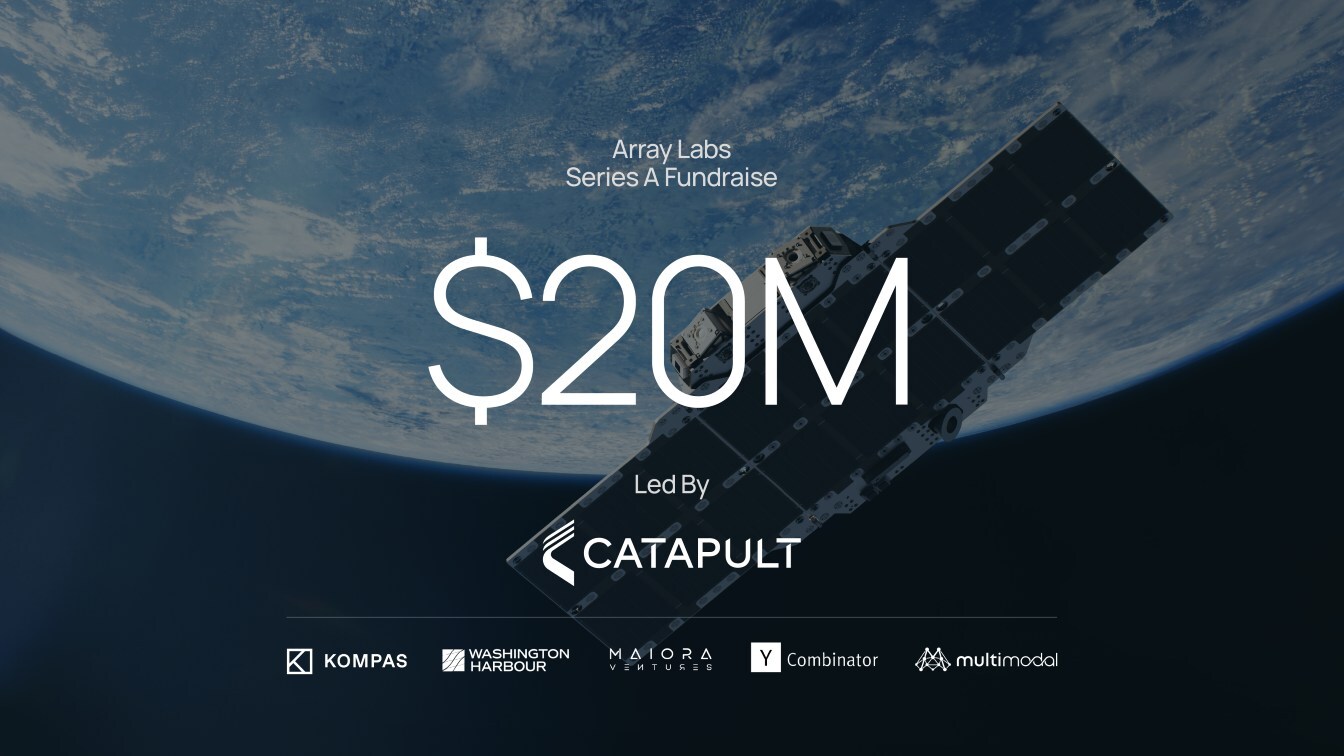
PALO ALTO, Calif., Jan. 5, 2026 /PRNewswire/ -- Array Labstoday announced a $20M Series A financing led by Catapult Ventures, with participation from Washington Harbour Partners, Kompas VC, and other new and existing investors, including Y Combinator, Maiora Capital, Animal Capital, Aera VC, Cultivation Capital, and Clearance Ventures. The round brings Array's total funding to $35M since going through Y Combinator. The company previously raised a $5M seed in 2022 after completing YC, followed by a $10M round in 2024.
Array has built what it believes is the first radar architecture capable of being mass-manufactured using techniques borrowed from consumer electronics and telecommunications - an approach that has allowed the company to collapse traditional cost structures while dramatically increasing performance.
"The radar satellite industry today looks like space launch beforeSpaceX: dominated by legacy defense contractors building bespoke, expensive systems one at a time," said Andrew Peterson, cofounder and CEO of Array Labs. "We've assembled a team from the most innovative technology companies in Silicon Valley to do something different: build radar that can be produced at scale, at commercial price points, without sacrificing capability."
In 2025, Array Labs doubled the size of its team, completed the design of its satellite bus, formed two new product lines, and grew commercial bookings to nine digits in contracted revenue. The company has also been selected for roughly half a dozen government awards over the last 24 months, across the U.S. armed services, intelligence community, and key combatant commands.
Business evolution: From "sell you an image" to "sell you a radar"
Array started with an ambitious goal: to launch clusters of small satellites that cooperatively image to create a real-time 3D map of Earth. As it matured its core technology, Array realized that the radar instruments it had built were extremely attractive to customers on their own.
The company formally reoriented to meet that demand, evolving from a vertically integrated remote-sensing data provider into a radar-first platform business. Consequently, Array now operates three business lines:
- Radar payloads:Standalone instruments for satellite bus providers and defense primes seeking very high-power, low-cost radar systems that can be mass-produced and integrated with any satellite bus.
- Sovereign satellite systems:Fully integrated spacecraft and dedicated clusters for customers who want to own and operate their own assets for wide-area, high-resolution ISR, and identification of targets on land, at sea, in the air, or in space.
- Data products:3D imagery and analytics from Array's owned and operated satellite constellation, delivered to commercial and civil customers.
Each business line builds on Array's core breakthrough: a family of radar instruments that deliver up to 100x the power of legacy systems at ~1% of the cost, packaged in form factors compatible with standard smallsats, scaled buses, and the larger platforms being designed for super-heavy launch vehicles like Starship and New Glenn.
Traction Across the Value Chain
Over the last two years, Array has been selected for several competitive U.S. government awards across the Air Force, Space Force, Navy, Army, U.S. Special Operations Command (SOCOM), and the Defense Advanced Research Projects Agency (DARPA) to advance the state of the art across high-power antenna architectures, high-bandwidth communications links, 3D reconstruction algorithms, and more.
On the commercial side, Array has signed multi-year capacity agreements for its first radar cluster with global leaders in mining, infrastructure, and embodied AI. These customers will use Array's 3D data and downstream analytics to monitor high-value industrial sites, plan and protect critical infrastructure, and feed better ground-truth information into autonomous systems. These are long-term workloads that want persistent, reliable capacity, rather than one-off imagery.
Meanwhile, demand for turnkey radar payloads is rapidly accelerating. The company will have an update to share in the coming months on payload sales, production scale-up, and growth plans.
Why radar, why now
Array has focused on perfecting the fusion of consumer electronics, communications technology, and advanced signal processing into radar systems that cost 10x less than traditional alternatives, while being capable of delivering 100x as much power. The company has built radar that is powerful enough for global detection and tracking missions like Golden Dome, packaged in a way that partners can quickly integrate and field new capabilities. These systems are further improved by Array's advanced AI-driven software, which transforms raw radar readings into actionable 3D intelligence rather than folders of static imagery.
With this Series A financing, Array will scale its engineering, product, and go-to-market teams; expand production capacity and meet growing demand for its radar panels; complete flight qualification; and ultimately, launch the world's first formation-flying radar satellite cluster.
About Array Labs
Array Labs is building the next generation of space-based radar systems. Based in Silicon Valley and backed by Y Combinator, Catapult Ventures, and Washington Harbour Partners, the company is preparing to launch the world's first formation-flying radar constellation. For more information, visit www.arraylabs.io.
Media contact:
Ryan Duffy, Head of BD
[emailprotected]
SOURCE Array Labs, Inc.

More Post from the Author
- Rokid Launches the World's First Open AI Ecosystem Smart Glasses -- Ultra-Light, Prescription-First, and Built to Work with ChatGPT, Qwen, DeepSeek, and More
- XREAL Announces Strategic Partnership with ASUS Republic of Gamers, Unveils ROG XREAL R1 AR Gaming Glasses
- ProLogium Technology Teams Up with Germany's FEV Group at CES to Showcase Next-Generation Solid-State Battery Module
- AWOL Vision Unveils Aetherion Series: The World's Sharpest 4K Triple Laser Ultra Short Throw Projector Delivering Industry-Leading Speed, Scale & Sharpness
- CTA: Despite Tariffs and Economic Headwinds, U.S. Consumer Tech Revenue to Hit $565 Billion in 2026